

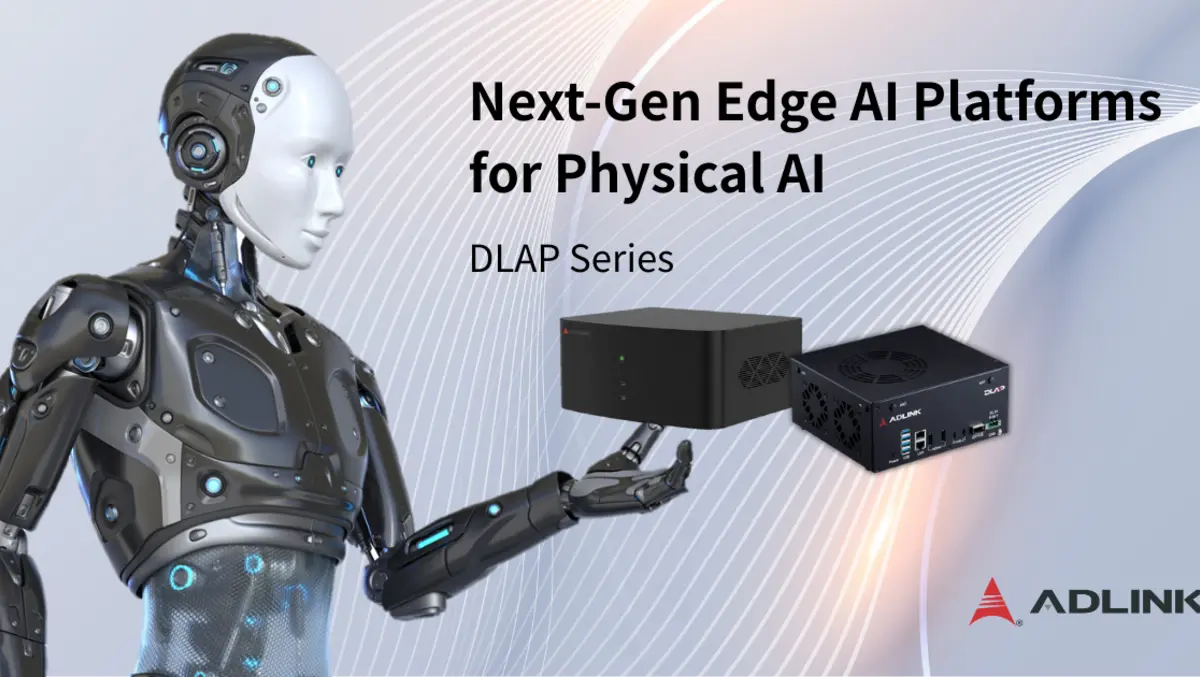

ADLINK has introduced a new range of edge AI computing platforms built around Nvidia's latest Thor hardware, targeting industrial robotics, medical imaging and autonomous systems.
The Taiwan-based embedded computing supplier said the new DLAP-IGX Series is built on the Nvidia IGX T7000, part of the IGX Thor platform. It also unveiled compact DLAP-700 family systems using Nvidia Jetson Thor modules, including the DLAP-701 and DLAP-711.
ADLINK positioned IGX Thor as a step up from IGX Orin for edge deployments that run large language models and vision-language models. It pointed to performance and connectivity gains, including up to 8x higher AI compute on integrated GPUs, 2.5x higher AI compute on discrete GPUs, and improved connectivity efficiency.
The announcement reflects a broader push to move more AI processing to the edge, closer to sensors and machines. That reduces reliance on cloud connections for time-sensitive tasks and supports safety-critical environments where systems must keep operating during network disruptions.
Safety focus
The DLAP-IGX Series sits at the top of the line-up. ADLINK described it as an industrial edge AI platform for use cases where real-time processing and safety requirements are central, including industrial robotics and humanoid systems.
The platform pairs an integrated Nvidia Blackwell GPU with the option of adding a discrete GPU. Configurations can include an Nvidia RTX PRO 5000 Blackwell for workloads running more than one generative AI model.
ADLINK cited peak performance of up to 4,293 TFLOPS using FP4-sparse calculations on systems based on the Nvidia IGX T7000. Vendors increasingly use such figures to indicate the upper bound of AI throughput, though real-world performance depends on the software stack, model architecture and thermal limits.
Networking is a key part of the DLAP-IGX positioning. The system integrates an Nvidia ConnectX-7 SmartNIC and supports dual 200 GbE QSFP28 ports, designed to handle high volumes of sensor data for machine vision and industrial automation pipelines.
For functional safety, the DLAP-IGX includes a dedicated Functional Safety Island on the system-on-chip, a safety microcontroller on the carrier board, and a board management controller for remote monitoring. The architecture is designed for deployments that require fault detection and managed operation alongside AI processing.
The platform includes PCIe Gen5 expansion with x8 and x16 slots, plus USB 3.2, supporting connections to frame grabbers, storage, networking cards and other specialised industrial peripherals.
Jetson systems
Alongside the IGX Thor-based system, ADLINK outlined two compact platforms based on Nvidia Jetson Thor. Both include a 14-core ARM Neoverse-V3AE CPU and support up to 128GB of LPDDR5X memory.
The DLAP-701 is positioned as a general-purpose platform for applications that require high-bandwidth memory, with medical image analysis cited as one example. It supports either the Nvidia Jetson T5000 or the Jetson T4000.
ADLINK cited AI performance of up to 2,070 FP4 TFLOPS for the DLAP-701. Connectivity includes two Gigabit Ethernet ports and one QSFP port supporting 4x 25GbE.
The DLAP-701 has a compact enclosure with a footprint of 211 mm x 194 mm x 94 mm. Its stated operating temperature range is -10°C to 35°C, suitable for controlled environments that still face industrial heat and dust considerations.
The DLAP-711 targets robotics deployments, including humanoid robots, vision sensing systems and autonomous mobile robots. It also supports the Jetson T5000 or T4000 and delivers the same AI performance of up to 2,070 FP4 TFLOPS.
Networking options are broader on the DLAP-711. ADLINK said it includes four Gigabit Ethernet ports, two 100M LAN ports, and a QSFP port supporting 4x 25GbE. The unit measures 224 mm x 124 mm x 85 mm and has a wider operating temperature range of -20°C to 65°C.
Software stack
The platforms support Nvidia AI Enterprise software, including Nvidia Isaac and Nvidia Holoscan, linking the hardware to Nvidia's developer tools and libraries for robotics and sensor-processing pipelines.
For industrial buyers, such bundling has become an important factor because edge AI projects often require long lifecycle support and repeatable deployment across a fleet of machines. It also underscores how hardware selection is increasingly tied to a software ecosystem and validation process.
ADLINK framed the new systems as part of a shift toward "Physical AI", a term used to describe AI models that interact with and respond to the physical world through sensors and actuators. In manufacturing and logistics, it is closely associated with robotics, machine vision and increasingly complex autonomy stacks running on-site.
The company also pointed to demand in medical computing, where local processing can support imaging analysis and other workloads that require predictable performance. These environments often impose constraints on latency, uptime and systems management, alongside regulatory expectations around safety and operational risk.
"By positioning Edge AI platforms powered by NVIDIA IGX Thor and NVIDIA Jetson Thor at the forefront of our line-up, we are addressing the urgent need for safe, high-performance computing in industrial and medical sectors," said Ethan Chen, General Manager of the Embedded Computing Platform Business Unit at ADLINK.
"The combination of NVIDIA Blackwell architecture and ADLINK's rugged engineering enables our customers to deploy Physical AI in environments where it was previously difficult," Chen said.
ADLINK expects deeper collaboration with Nvidia as the market for robotics and humanoid systems expands, and more AI inference shifts to machines operating at the edge.