

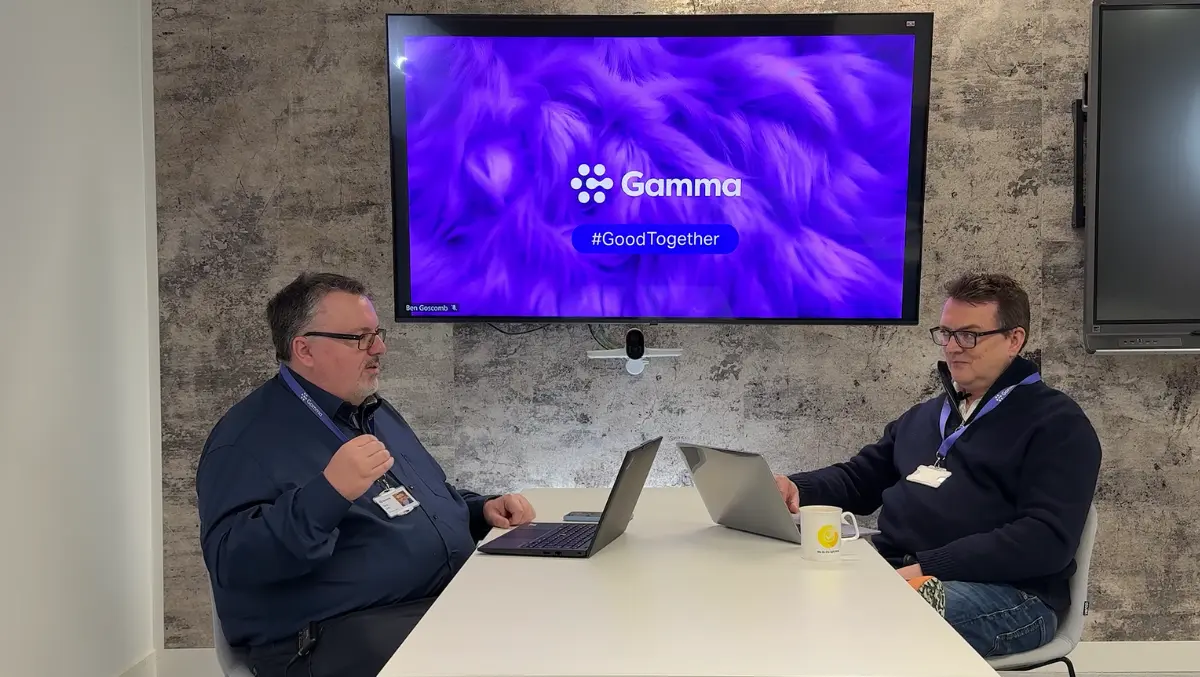
Gamma champions quick CX wins to cut friction & risk
Wed, 18th Mar 2026.webp)
Organisations running customer experience (CX) programmes often face a familiar problem: large contact centre and service change projects can take months. Teams spend long periods planning and implementing, and staff and stakeholders may not see tangible benefits until late in the process.
Gamma's customer experience practice emphasises early "quick wins" alongside longer-term plans. The approach is designed to keep projects moving and give teams evidence that change work delivers results in day-to-day operations.
"Projects can be quite long, and they can be quite difficult, and people can get lost in the detail. It helps keep the momentum going and gives people the confidence that what they're doing is the right thing. If you get too far down the line and you're still stuck with the details of implementation and there's no discernible benefit, questions can start rising in people's minds about why they're doing it and what's going to come out at the end of it."
Quick wins can also help challenge assumptions based on other organisations. Buyers often ask suppliers for examples and case studies, but Gamma argues those only go so far because service operations vary across sectors and even between similar organisations.
"Absolutely. Every organisation is slightly different. They've got different priorities and pressures. Whilst it's useful to see how other people have done it, it's always going to be different in every organisation. That's one of the key things that we do, because we do this every day: getting very quickly to understand what people's pain points are, how we can address them, and how we can move people through it quickly and as easily as possible," said Richard Hall, Director of CX Solutions, Gamma Enterprise.
Hall pointed to customer journey friction as one of the first areas to examine, across both voice and digital channels. Customers may face too many steps before reaching the right outcome. He also described targeted automation as a way to reduce effort in narrowly defined areas, while keeping work controlled and avoiding major integration.
"Customer experience - that's where the friction usually manifests itself most readily. Where people are struggling to get through, either on the voice or digital side of things such as web chat, there might be too many layers to get through to where you need to get to. That means that when customers end up speaking to somebody, they're frustrated. There are very quick things we can do around automation to make sure that customers are served as quickly as possible, so you don't have to speak to somebody necessarily. You can do that in a very safe, quick, controlled way, without having to get into big data integration or anything like that. You can take small chunks of functionality and automate those in a very controlled way, in parcel-sized chunks," Hall said.
During implementations, Gamma also uses what it calls a "model office", which it describes as a way for customer teams to experience a proposed service design and operational changes early. Hall said teams often work from abstract documents during procurement and design, which can make it hard to understand how day-to-day work will change.
"It shows them what they're going to get. It can be quite difficult - everything is very abstract when you're going through statements of work, doing proposals, and then through to design. Until you create something tangible and real for people, it can be hard to see what it's going to look like. There can be fairly large changes that people have to go through. If you've had CX established for a while on different systems or using different methodologies, you've got different reporting and different metrics. All of these things can change quickly, and it's hard unless somebody can actually see it, touch it, feel it, and work with it in a controlled way. The model office helps you do that. It also helps de-risk things because, if people want to iterate over different models and approaches, you can try them out in the model office first to see where the rough edges will be before you implement," Hall said.
Gamma also highlighted "proof of value" projects, which it framed as narrower than a full contact centre deployment. It describes these as defined pieces of work focused on a specific challenge and a shared definition of success. The approach also comes up in conversations about artificial intelligence (AI) in service settings, where buyers often struggle to choose a first use case.
Hall said organisations face uncertainty over AI in contact centres because established reporting and measurement approaches do not always translate. Teams may also lack experience of common pitfalls and how to define success when tools behave differently from traditional systems.
"It's a new world. AI - nobody's sure what it's going to look like. Contact centres and CX have been around for a long time, and people have very established ways of doing things. They know where the hard edges are, what reporting they need, and how to drive the best outcomes and efficiencies. That context has changed significantly, and it's happened overnight. Nobody has any real hard experience of it, so they don't know where the pitfalls are, what it's going to look like for them, or how they report back and say, 'Yes, we've succeeded.' Even the idea of success has changed," Hall said.
For Hall, low-risk CX work rests on two priorities: protecting customer data and protecting the customer experience during change. He described staged work and "guardrails" around AI, and suggested starting with simpler use cases such as knowledge base automation. He said this can remove low-effort queries and free staff time for more complex issues.
He also highlighted the risk of adding friction during process change. Reporting frameworks may need revision as organisations add automation and AI, and he pointed to quality management approaches that monitor performance in real time.
"The risk is around two things: the security of customer data, which is paramount, and securing the overall customer experience - making sure you're not adding friction or frustrating customers. On security, it's about being very clear on how the data is controlled. Within the AI world, you have guardrails, and multiple layers of guardrails. You want to go through that in steps and not start with the most complicated use case, because data security is not simple. Taking something like a knowledge base and automating it allows you to remove day-to-day, low-effort queries. That gives colleagues time to deal with more complicated, higher-value cases. Even if you're automating low-value transactions, what you're really giving back is time - and that's what contact centres struggle with most. The other part is not adding friction. Reporting metrics that worked in the past may not work in this new world, and we can help make sure reporting accurately reflects what's happening, both in real time and historically. Time-based quality management is also a real help. AI can be non-deterministic, so you can't always predict what's going to happen. Real-time, AI-driven quality management lets you identify friction hotspots quickly and make changes to control the overall customer experience," Hall said.
In early CX refinement work, Hall said teams should map the customer journey across voice and digital channels. In large organisations, fragmented ownership can pull journeys apart. He also pointed to legacy elements in systems that persist after the reason for their existence has faded, and said teams should challenge those elements before carrying them into new setups.
"If you're talking about traditional voice and digital, it's about working through the customer journey. In larger environments, you often have multiple stakeholders, which can lead to a fragmented journey. Different ambitions and goals can pull things apart, so bringing people together to create a cohesive journey is critical. Especially where systems have grown over time, there can be historical cruft that sits in the system, and it needs to be refined down. The first thing is to go in and find out what's really needed, because corporate memory wanes and people don't remember why things are there. You must challenge and make sure things are there for a good reason, so that when you build this out, you're not just doing the same old stuff again with a new shiny label on it," Hall said.
Hall also described how digital channels change the structure of customer journeys. He said customers and agents do not always need to complete interactions in a single session, and pointed to SMS and messaging channels where journeys can move between voice and digital with gaps between responses.
"When you start looking at digital - SMS, WhatsApp, RCS, Apple Business Chat, Facebook - they allow for a very different set of interactions. It can be asynchronous. People tend to think in a linear way about how a customer journey might look, but that changes considerably in the digital world. You can start on voice, then move into a digital journey for updates, and maybe move back to voice or over to video. It doesn't really matter, but it requires a different set of planning. There may be ten, twelve hours or even days between responses from a customer, and that's fine if they're getting what they need," Hall said.
Gamma positioned quick wins as a route to familiarity and confidence. Hall said early outputs show what is possible, and help teams see how they can change workflows themselves in newer systems-a shift for organisations used to supplier-led change cycles.
"The quick win isn't the goal. It's to show what's possible and take people through the steps - effectively training them and giving them familiarity with a system they may not have seen before, or ways of using it they haven't considered. The win is getting customers to say, 'Oh, I can do that.' Customers can do a lot themselves now through self-service, and that empowerment is a step change people aren't used to. Once we show them what's possible and how easy it is, they gain the confidence to start iterating themselves, making changes and thinking about it differently, so they can get the best for their customers," Hall said.