


PC shipments to plunge in 2026 on memory shortages
Mon, 16th Mar 2026
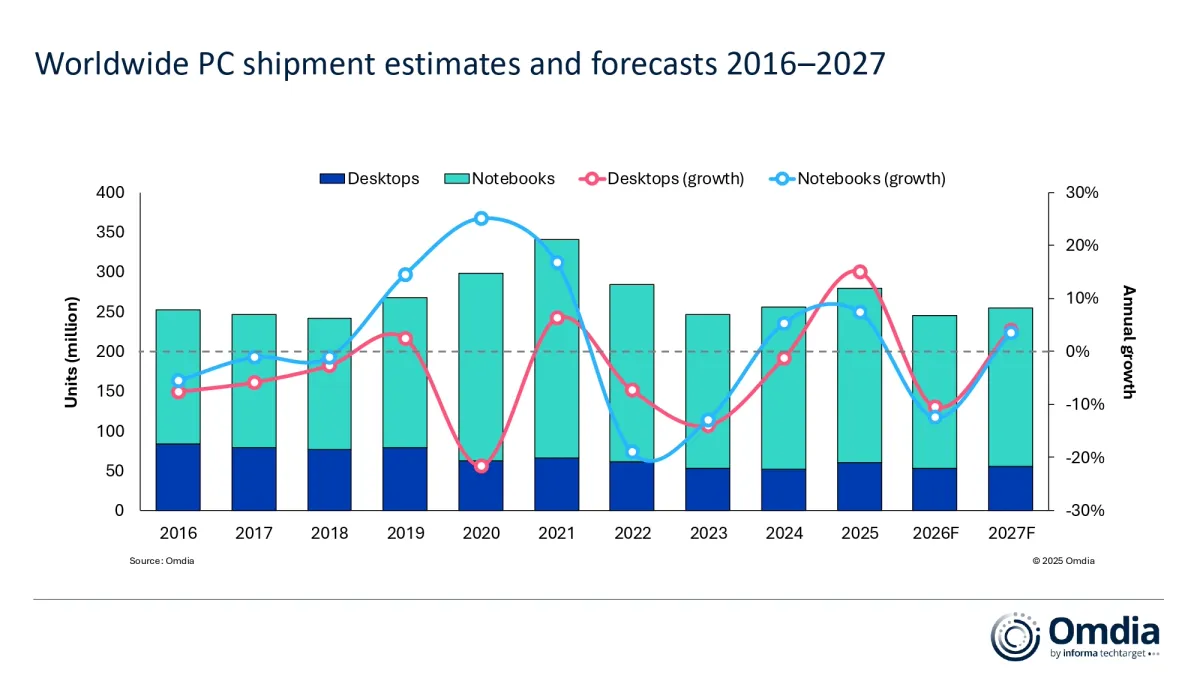
Global shipments of desktops, notebooks, and workstations are forecast to fall 12% in 2026 to 245 million units, as memory and storage shortages lift component costs and drive higher PC prices.
The latest outlook from analyst group Omdia links the decline to sharp increases in memory and storage prices. It expects prices to rise by at least 60% in the first quarter of 2026, with further increases through the year, though at a slower pace.
Since the first quarter of 2025, the cost of mainstream memory and storage configurations has risen by USD $90 to USD $165, adding pressure to PC makers' margins. In response, vendors have cut promotions, raised end-user prices, and adjusted configurations.
The downturn is expected to be broad-based across form factors. Desktop shipments are projected to decline 10% to 53.2 million units, while laptop shipments are forecast to fall 12% to 192.2 million units.
"For lower-priced products, there is less margin room to absorb rising costs, and consumers in this segment are typically more sensitive to price fluctuations," said Ben Yeh, Principal Analyst at Omdia.
Downside risk
Omdia has run multiple scenarios as market conditions shift quickly. Its base case carries elevated downside risk, driven by the possibility that shortages in both memory and storage widen and price increases steepen. Under that scenario, shipments could decline by around 15% or more.
The group also flagged uncertainty from the recent outbreak of conflict in the Middle East, which has added risk to international transportation and regional market growth. The duration and impact remain unclear.
Price bands
Omdia's analysis by price tier suggests shortages and price increases are affecting the market unevenly. Lower-priced systems face the greatest exposure because they typically offer less margin headroom and rely more on older, lower-capacity components.
Yeh said lower-price products may also receive lower allocation priority and face additional disruption as some suppliers discontinue production of older components. "Within the limited bit supply PC vendors could obtain, prioritizing premium products will be a preferred strategy to mitigate impacts to business performance," he said.
PCs priced below USD $500 are expected to see the steepest decline, with shipments forecast to drop 28% to about 62.1 million units in 2026. Omdia also points to discontinuations of some memory and storage products used in lower-cost models, creating an added constraint beyond price.
Higher-priced systems are expected to hold up better. Omdia expects PCs priced at USD $900 and above to post modest growth, supported by greater ability to absorb cost increases and by buyers accepting higher prices for essential purchases. The overall market mix is also expected to shift upward in price, even if that does not translate into higher specifications.
"Beyond the stronger ability of higher price bands to absorb cost increases, we also factored in that some consumers and IT decision makers will accept higher price points to meet essential needs, which will drive an upward shift in the price mix," Yeh said. "However, the movement toward higher price bands does not necessarily represent improved product configurations."
Platforms split
Omdia expects the supply shock to affect operating system platforms differently, based on buyer profiles and supply chain positions. Windows PCs remain the largest segment, accounting for 83% of shipments, and are forecast to fall 12% in 2026 as constrained memory and storage supply feeds through.
Chrome devices are expected to see the steepest platform decline, with shipments forecast to drop 28%. Omdia said the education-heavy segment is particularly exposed because procurement budgets are tighter and devices are often purchased at lower price points.
Mac shipments are set for a smaller 5% decline, which Omdia attributed to Apple's supply chain structure and focus on higher-priced products.
HarmonyOS-based PCs are expected to grow from a small base as Huawei expands its PC ecosystem in China, according to the forecast.
"The supply-driven downturn in 2026 will not affect all PC platforms equally," said Kieren Jessop, Research Manager at Omdia. "Windows PCs, which account for 83% of shipments, are forecast to decline 12% in 2026 as the platform bears the brunt of memory and storage constraints. Chrome devices face the steepest decline at 28%, as the education-heavy platform is particularly exposed to tighter component allocation, lower margins and the discontinuation of some memory and storage products. Macs are set for a comparatively modest 5% decline, supported by Apple's vertically integrated supply chain and premium positioning. Meanwhile, HarmonyOS-based PCs are emerging as a notable growth segment, forecast to expand tenfold year on year from a small base as Huawei ramps up its PC ecosystem in China."
PC vendors are expected to keep adjusting product line-ups and pricing through 2026 as shifts in memory and storage allocation and costs shape which configurations reach the market and which price points remain viable.