


Atlassian has rebuilt its search infrastructure on OpenSearch to support artificial intelligence workloads, multi-tenant scale, and global compliance requirements, running more than 300 clusters across 13 regions while delivering AI-powered search to more than two million users each month.
The company, known for products such as Jira, Confluence, and Trello, moved away from a PostgreSQL-based search architecture after it struggled to keep up with growing demand for contextual search, large-scale indexing, and AI-driven features. The transition placed OpenSearch at the centre of Atlassian's platform strategy, supporting new services including Rovo, its enterprise AI assistant, and RovoDev CLI, a developer productivity tool.
Today the platform manages more than 20 billion documents across the largest clusters and operates on a Kubernetes-native foundation designed to provide consistent performance across cloud regions, isolated environments, and customer-specific deployments.
Scaling search beyond relational limits
Atlassian's earlier search system relied heavily on PostgreSQL, which limited performance as the number of tenants, documents, and queries increased. The company needed a system capable of handling large-scale indexing while maintaining predictable latency for millions of users.
Moving to OpenSearch solved the scalability problem but introduced new engineering constraints. Jira required read-after-write consistency, which is not native behaviour for distributed search engines. Atlassian also needed to support hundreds of thousands of tenants without exhausting cluster memory, and had to operate across multiple cloud providers while meeting strict encryption and data residency requirements.
Observability created another challenge. Standard managed services exposed metrics only at the cluster or node level, which made it difficult to analyse behaviour at the tenant level or detect performance issues affecting individual workloads.
Building a managed OpenSearch platform on Kubernetes
To address these issues, Atlassian built a fully managed OpenSearch platform running on Kubernetes, combined with a centralised control plane that standardises configuration, security, and deployment across environments.
Migrating Jira's query engine to OpenSearch delivered immediate performance gains, while custom routing logic allowed tenants to be mapped efficiently to shards. The architecture was also designed to maintain read-after-write behaviour, ensuring that search results remain consistent for collaborative workflows.
The central control plane enforces encryption policies, manages index changes, and handles customer-managed keys. It also supports region-specific data residency requirements and enables controlled rollouts across hundreds of clusters without manual intervention.
The platform uses open source tools including Argo CD for deployment automation, Karpenter for node provisioning, and Prometheus with OpenTelemetry for monitoring and tracing. Atlassian also relies on availability zones and pre-provisioned storage volumes to improve recovery times for stateful services.
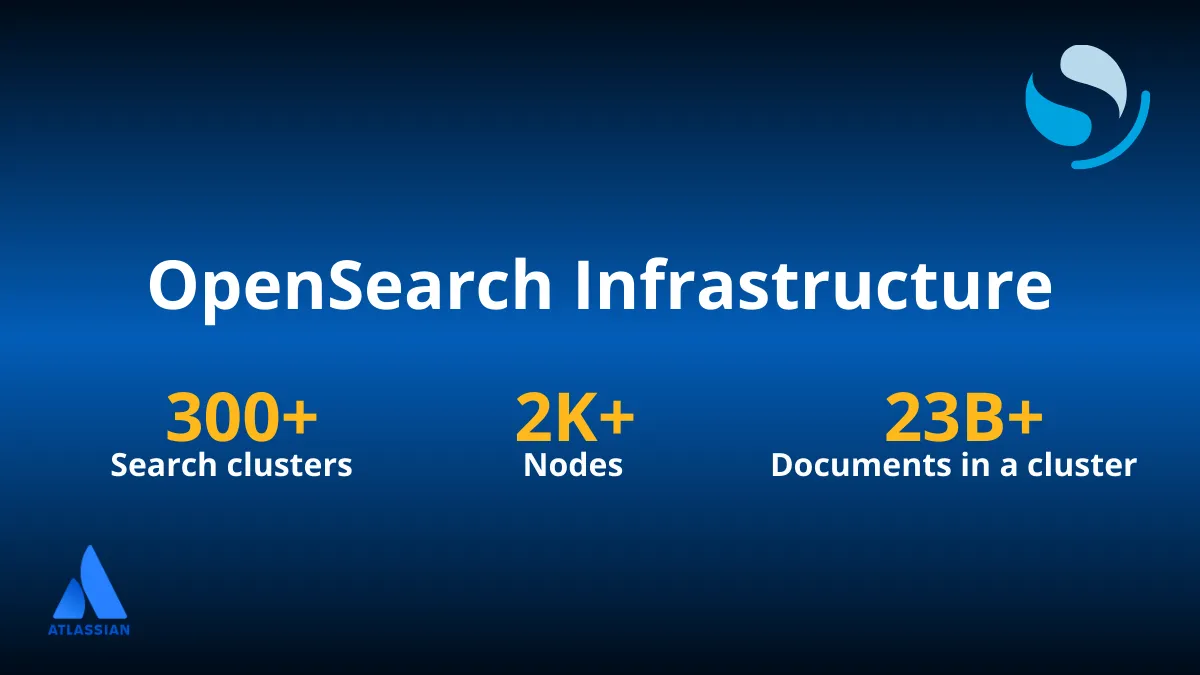
This approach allows the company to run more than 300 OpenSearch clusters with over 2,000 data nodes while maintaining 99.99 percent availability.
Supporting AI search and developer automation
The OpenSearch platform now underpins several of Atlassian's AI-driven features.
Rovo, the company's enterprise search and AI assistant, combines semantic, lexical, and structured search to retrieve information across more than 50 software-as-a-service applications. The system uses Atlassian's Teamwork Graph to understand relationships between users, documents, and projects, allowing it to generate answers that respect permissions and organisational context.
The same infrastructure also powers RovoDev CLI, a command-line assistant designed to improve developer productivity. By analysing code changes and surfacing issues earlier in the workflow, the tool reduced pull request cycle times by 45 percent during internal use.
These capabilities rely on the ability to index large volumes of user-generated content and retrieve relevant results quickly across distributed environments, which was not practical with the previous database-centric architecture.
Operating across regions and compliance boundaries
Atlassian now supports more than 300,000 customers across global cloud regions, government environments, and isolated deployments that require strict security controls.
The centralised control plane plays a key role in managing this complexity. It applies consistent policies across clusters, enforces encryption requirements, and ensures that data remains within the correct geographic region when required by customers or regulators.
Automated rollout tools allow new features to be deployed safely across hundreds of clusters, while observability tooling provides visibility into performance at both the cluster and tenant level.
These capabilities allow the platform to operate at large scale without increasing operational overhead, even as the number of users, documents, and AI workloads continues to grow.
A foundation for AI-ready infrastructure
Atlassian's adoption of OpenSearch shows how distributed search engines can become the backbone of AI-driven enterprise platforms.
By combining Kubernetes orchestration, a centralised control plane, and open source observability tools, the company built a system that supports multi-cloud deployments, regional compliance, and high-volume indexing while maintaining consistent performance.
The result is a search platform that can scale with growing AI usage, support complex collaboration workloads, and deliver reliable service across hundreds of clusters worldwide.
As organisations expand their use of AI assistants and contextual search, the ability to operate OpenSearch at scale is becoming a core requirement for modern software platforms.