

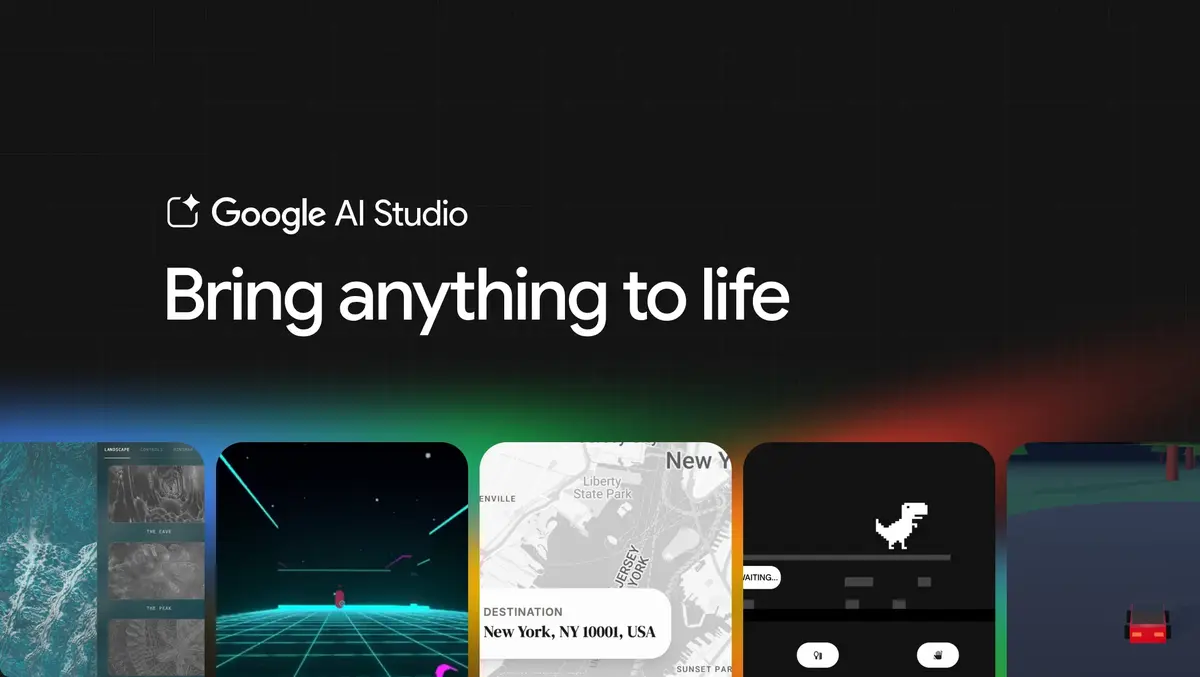

Google has added a full-stack coding environment to Google AI Studio, centred on a new coding agent called Antigravity.
The update is designed to turn text prompts into working web applications within the same interface. It adds built-in Firebase services for database storage and user authentication, and expands framework support to include Next.js alongside React and Angular.
The move pushes Google AI Studio beyond prompt-based prototyping into full app development covering both front-end and back-end work. Developers can now create applications with persistent data, user sign-in and connections to external services without leaving the tool.
One of the main additions is support for multiplayer and collaborative software. The system can be used to build real-time games, shared workspaces and other applications that require several users to interact at once.
Backend setup is handled through Firebase integration. Google says the coding agent can identify when an application needs a database or login function and, with user approval, provision Cloud Firestore and Firebase Authentication with Google sign-in.
Broader tooling
The agent can also draw on external web development libraries when needed. In Google's examples, it may install tools such as Framer Motion for animation or Shadcn for interface components if the app requires them.
That reflects a broader push to make AI-generated code more practical for production use. Rather than limiting output to simple prototypes, the updated AI Studio aims to help users build applications that rely on standard web frameworks, third-party packages and secure access to external APIs.
Users can now add their own API credentials for external services, including databases, payment systems and Google products such as Maps. Keys are stored in a new Secrets Manager in the product's settings area.
Another change is session persistence. Users can close a browser tab and return later, with their work state retained across devices and sessions.
Project context
The upgraded agent is also designed to retain more context from the user's project and earlier prompts. Google says that should allow it to make more precise code edits across multiple steps and handle more complex applications from simpler instructions.
Support for Next.js is notable because the framework has become a common choice for modern web application development. Adding it alongside React and Angular widens the range of projects that can be started directly inside AI Studio.
The announcement comes as major technology companies compete to make AI coding assistants more central to software development workflows. Many of these products began as tools for code completion or chat-based help, but have since moved towards generating larger portions of applications and linking them to cloud services.
Google says the new AI Studio experience has already been used internally to build hundreds of thousands of applications in recent months, offering one measure of how heavily it is testing AI-assisted development before broader external use.
For Google, the update also gives Firebase a more direct role in its AI development tools. By linking generated applications to Firestore and Firebase Authentication in the same flow, it ties app creation more closely to its own cloud and developer services.
This may help address one of the more persistent limits of AI coding products: the gap between producing a demonstration and delivering software that handles identity, saved data and service integrations. Google is positioning AI Studio as a place where those pieces can be assembled in one workflow rather than stitched together later.