

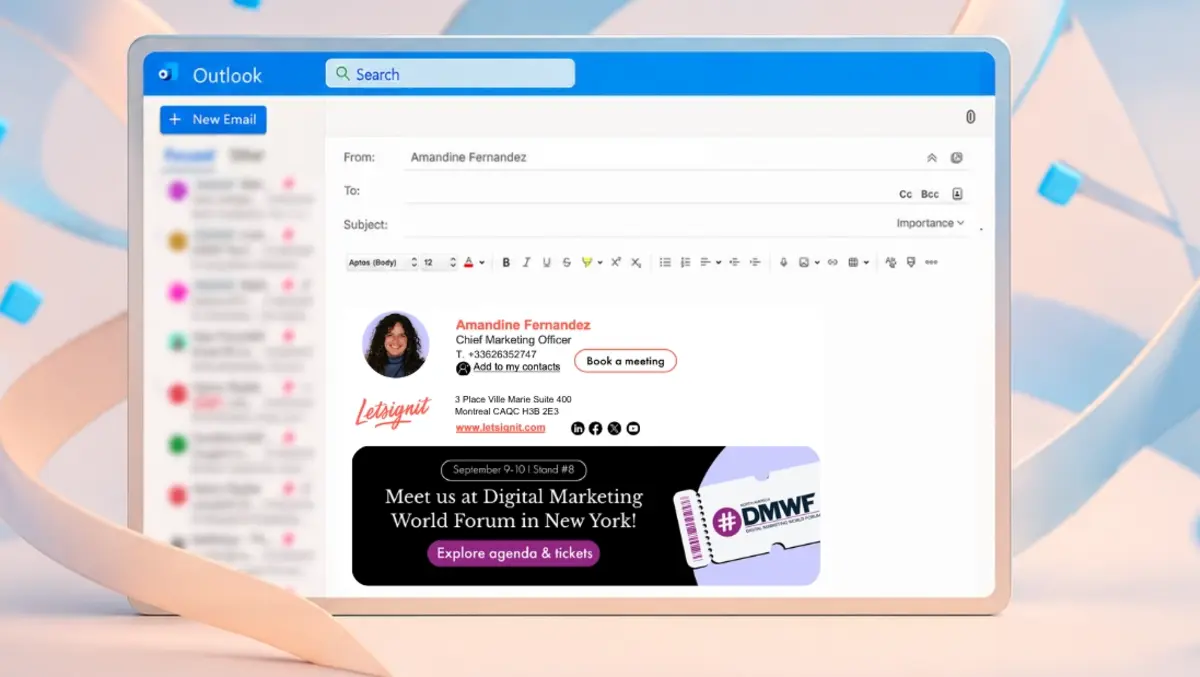
Letsignit pitches centralised email signatures for firms
Fri, 6th Nov 2026 (Today)
Letsignit is pitching organisations on reducing IT involvement in routine email signature updates. It argues that the process can be centralised while allowing business teams to manage some changes themselves.
Email signature management is often treated as a minor administrative task, but in large organisations it can generate a steady flow of support requests. Changes for new starters, job title updates, departmental moves and branding revisions may require repeated intervention if there is no central system.
The issue becomes more complex in organisations with multiple departments, subsidiaries or countries. Different parts of the business may need distinct branding, contact details or legal wording, while employers still want consistent controls across their email systems.
Letsignit is targeting that problem with a central platform for signature administration, branding and communications management. The system is designed to let IT and business functions work within a shared structure, with different responsibilities assigned to each group.
Directory sync
A central part of the approach is synchronisation with corporate employee directories. Letsignit says it supports Microsoft Entra ID and Google Workspace, allowing signature data to align with employee records already held by the organisation.
That means details such as job titles and departments can be updated through an existing synchronisation process rather than edited manually in separate tools. The model is intended to cut duplicate data entry and reduce the risk of inconsistent records appearing in outbound email signatures.
Single framework
Organisations can also manage different signature requirements from one administrative environment, according to Letsignit. Assignment rules are intended to help companies apply variations across teams, entities and subsidiaries without creating separate workflows for each group.
For multinational businesses, that could matter where one business unit needs a different signature format from another, or where local requirements vary by market. The platform is positioned as a way to preserve that flexibility while keeping administration in one place.
Email tools
Letsignit has also focused on compatibility with existing email environments. For organisations using Microsoft 365 and Outlook, it offers deployment options that fit into current email workflows, subject to technical configuration.
The aim is to remove the need for employees to create and maintain their own signatures. In practice, that addresses a common problem in large companies, where staff-editable signatures can lead to inconsistent layouts, outdated information and missing legal text.
Business access
Another part of the argument is that email signatures sit between technical administration and corporate communications. IT teams oversee deployment and system integration, while Marketing and Communications teams often need to manage design, branding and campaign messages carried in everyday email traffic.
Letsignit says authorised business users can manage signature designs and email communication campaigns within a centrally administered environment, while IT retains oversight of the technical set-up. It argues that this division could reduce dependence on helpdesk tickets for every branding update or campaign amendment.
The wider commercial case rests on a familiar challenge for enterprise IT departments: the build-up of routine requests that consume time after a system has already been deployed. In that sense, email signatures are less a standalone issue than an example of small administrative processes that continue to draw technical staff into repetitive work.
Security remains part of the discussion because signatures draw on employee data and sit within company email systems. Letsignit says centralised management and directory synchronisation can reduce manual handling and lower the risk of human error when records are updated.
It also points to its ISO 27001 and ISO 27018 certifications as part of its information security and data protection credentials. That may matter for organisations weighing whether a signature management tool can be adopted without creating another loosely governed layer in the email environment.
Letsignit's message is that companies do not need to treat every signature change as an IT task. Instead, it presents email signature management as an area where central administration, system integration and delegated business control can reduce operational friction for overstretched technology teams.
Its core argument is simple: routine signature changes do not always need to sit in the IT queue.