

LG unveils ThinQ Claw AI agent for connected home platform
Tue, 1st Sep 2026
LG has unveiled the next version of its AI Home system at IFA 2026, introducing a new text-based AI agent called ThinQ Claw.
The broader AI Home platform uses contextual intelligence to analyse schedules, routines, appliance usage and home conditions to recommend actions and coordinate connected devices and services.
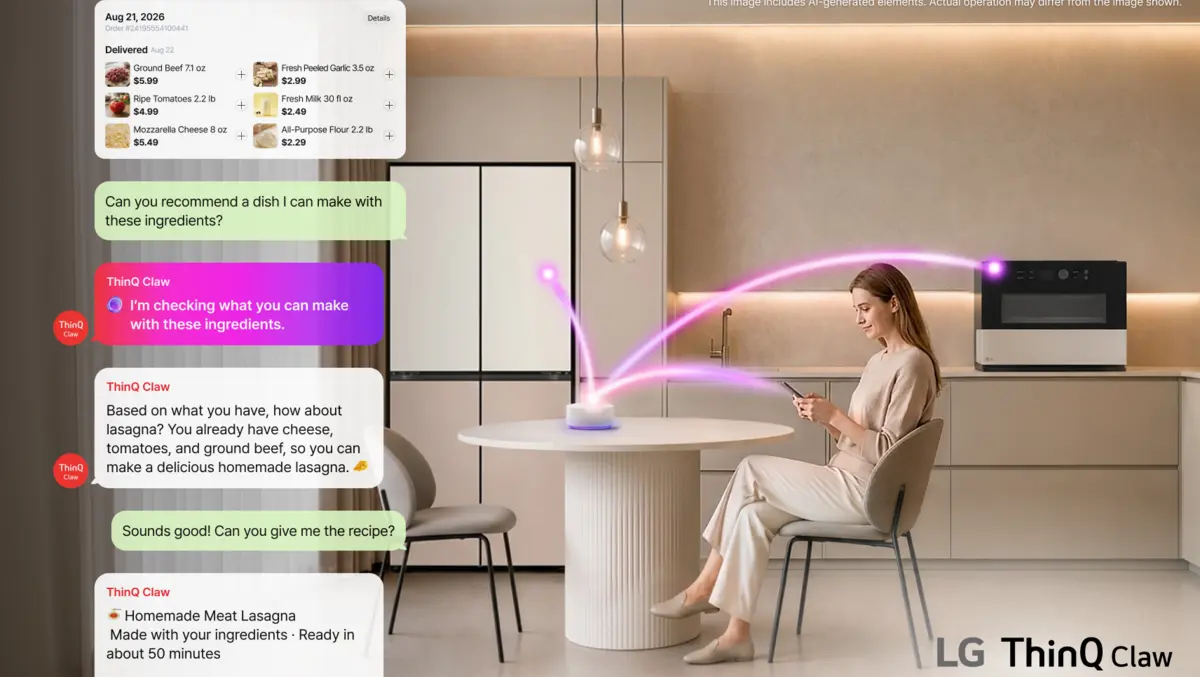
At the centre of the announcement is ThinQ Claw, which adds chat-based interaction to LG's home platform. Users can describe plans or changes in their day through a natural language interface, and the system is designed to interpret those updates in context rather than as isolated commands.
That allows the agent to link tasks across appliances and services. It can help prepare cooking appliances for hosting guests, adjust indoor air quality and temperature before a user returns home, and suggest activities or settings based on preferences and circumstances.
The system also works with calendars and other connected services. Rather than relying on fixed automation routines, it is intended to let people manage devices by sharing their plans or current situation in a conversational format.
Home platform
The broader AI Home ecosystem shown alongside ThinQ Claw is built around Homey, the smart home platform developed by Athom, which LG acquired in 2024. Homey is intended to let users manage products from multiple manufacturers and service providers in one place.
LG used the announcement to underline the importance of interoperability in connected homes, where consumers often own devices from different brands. By presenting Homey as the control layer for its ecosystem, LG is signalling that its AI Home strategy extends beyond its own appliances.
A home energy management demonstration formed another part of the rollout. The system can connect smart meters, solar panels, home batteries and electric vehicle chargers with appliances to manage generation, storage and consumption in real time.
According to LG, this setup can help households reduce electricity costs by shifting when power is generated, stored or used, including in markets where dynamic energy pricing is available. That places the AI Home push within a broader effort by appliance makers to tie smart home software more closely to residential energy systems.
Beyond the home
LG also highlighted ThinQ Pro, a version of its platform aimed at multi-family residential and commercial settings. The product supports the management of devices and facilities in shared and professional environments, extending the same software approach beyond private homes.
The expansion suggests LG is seeking to position its connected home software as a broader building and facility management platform, as well as a consumer appliance interface. That could put it in closer competition with groups developing smart building systems for landlords, property operators and commercial sites.
Security was another part of the announcement. LG said its Shield framework is applied across connected appliances, services and customer data within the AI Home ecosystem.
LG did not provide market-specific availability for Australia and New Zealand, and local specifications have yet to be confirmed. The announcement was issued by the company's headquarters in Korea.
Consumer electronics groups have increasingly used artificial intelligence features to differentiate refrigerators, air conditioners, washing machines and other household products. But the focus has shifted from simple voice control and remote access towards software that can infer intent from behaviour, schedules and environmental conditions.
For LG, the introduction of a text-based agent reflects that shift. Rather than asking users to set up detailed workflows in advance, it is presenting conversational interaction as a simpler way to manage a network of products and services across the home.
The approach also reflects a broader move in the technology sector towards AI assistants that retain preferences over time. LG said ThinQ Claw can remember likes and dislikes, which it argues will allow increasingly personalised responses as customers continue to use the system.
"ThinQ Claw marks the next step in LG AI Home, illustrating how AI can understand customer intent and life context to support a more personalised and streamlined daily experience," said Baek Seung-tae, President, LG Home Appliance Solution Company.
"LG will continue advancing AI Home through innovations that are increasingly intuitive and responsive to customers' needs," Baek said.