

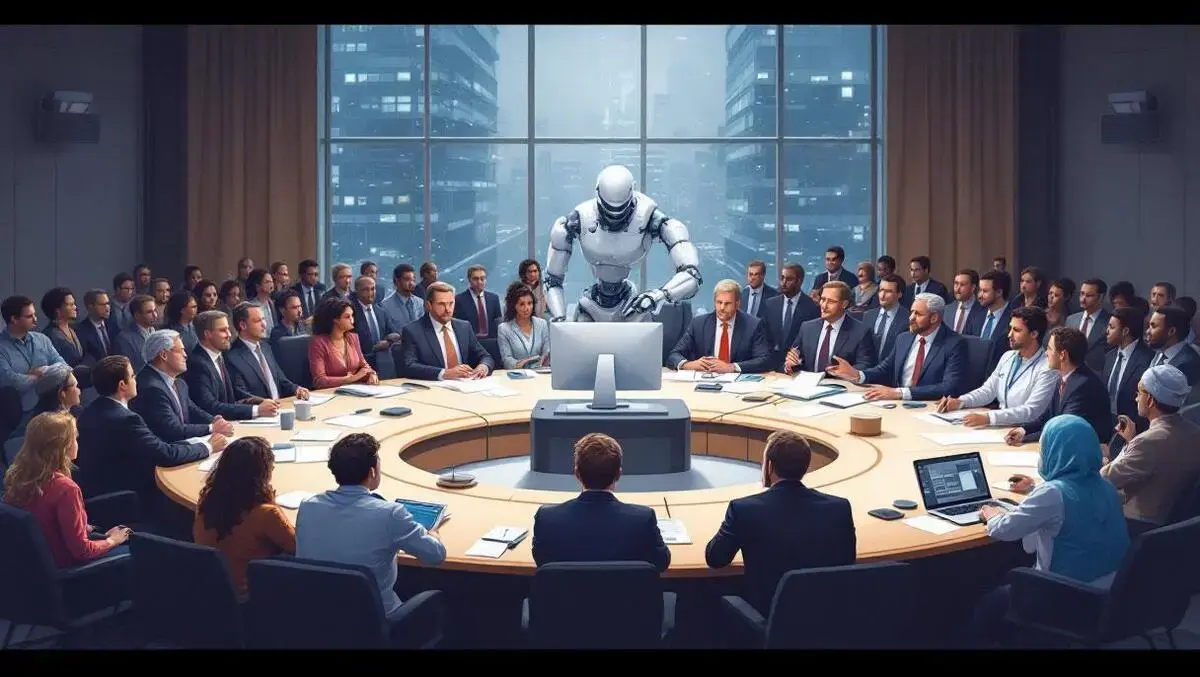

OpenAI has published a policy blueprint on the impact of increasingly advanced artificial intelligence systems, saying it is meant to begin a public debate on how societies should respond.
The discussion around the blueprint focused on the prospect that AI systems could become far more capable within the next few years. Senior OpenAI figures argued that governments, businesses and the public need to prepare for economic and social disruption, alongside potential benefits in science, healthcare and entrepreneurship.
Chief Executive Sam Altman said OpenAI believes progress is accelerating. "The biggest reason is simply that the rate of progress is continuing to accelerate, and we believe we are very close now. And this won't be a one-time thing.
This will be over the next few years, to powerful models that will impact the world in important ways," Altman said.
He said publishing ideas early was intended to create time for debate before decisions become urgent. "One thing I've observed from watching the world go through some number of transitions is that the more time the public, our leaders, the political system, has to debate ideas before you really have to make a decision, the more likely you are to make a good decision," he said.
Research input
Researchers were involved early in drafting the document alongside policy staff. Adrienne, an OpenAI researcher, said the process pushed technical staff to move from abstract discussions about safety and economics to more concrete proposals.
She said internal use of AI had changed quickly. Researchers who once wrote most of their own code had shifted towards having AI write much of it, reinforcing the sense that the technology was moving faster than many outside the sector realised.
Altman likened the mood inside OpenAI to the early weeks of the pandemic, when some researchers believed a major change was imminent before the wider public had absorbed it. He said the difference in this case was that the shift would be driven by AI systems already in use.
At the same time, OpenAI presented the technology as a source of broad economic gains. Altman said AI could compress years of scientific work into much shorter periods, help discover treatments and materials, and allow more people to start companies with limited resources.
"If we can really go make a decade's worth of scientific progress in a year. If we can go cure a ton of diseases. If we can come up with personalized medicine for people. Find new materials to sort of make cheap, safe energy. If we can make it such that anybody who can come up with an idea for a startup and have the AI implement it," Altman said.
Resilience debate
Much of the discussion focused on resilience rather than model-level safeguards alone. Speakers argued that testing and restricting models would remain necessary, but would not be enough if other actors released systems with fewer controls or if open models made dangerous uses harder to contain.
Adrienne pointed to incident reporting as one example, comparing it with aviation systems that log minor failures and near misses so lessons can be shared across an industry. She also said stronger cyber defences would be needed as models improve at writing and analysing software.
Altman described this as a shift from what he called "classical AI safety thinking", which assumed a small number of systems could be aligned and managed in isolation. In his view, a world with many advanced systems will require a broader social response.
He argued that cyber security would become a central issue because AI systems are likely to become much better at finding weaknesses in software. Defensive use of AI, he said, would therefore need to expand quickly across governments and companies, especially in critical infrastructure and older systems that are difficult to patch.
He made a similar point on biological risks, saying restrictions on model outputs alone would not be enough. Detection systems and rapid-response measures would also be needed.
Work and tax
Josh, OpenAI's chief futurist, said the economic case for AI should include ordinary workers and lower-income countries rather than concentrating gains among wealthy individuals and large companies. He said AI could reduce the cost of meeting basic needs such as healthcare, shelter and electricity, but only if policy choices support broad distribution.
That led to discussion of labour market disruption and social policy. Josh said workers are already worried about replacement and surveillance, and that any serious plan for workplace deployment would need stronger safety nets and greater worker involvement in decisions about acceptable use.
Ideas discussed included portable benefits, greater union input into workplace deployment, stronger measurement of economic change, and transitional support if disruption accelerates. The blueprint also referred to proposals such as a shorter working week and tax reform for an economy in which more intellectual labour is done by AI systems.
Altman said current tax structures may not fit a world in which machine systems perform much of today's white-collar work. "I do suspect that we're gonna have to make changes to how we tax like in a world where AI is doing Most of the intellectual work in the world or at least of the work of today," he said.
He also said wider access to computing resources would be crucial to avoid a concentration of power. In his view, limited supply would allow the richest companies and individuals to dominate access, while abundant infrastructure could spread the benefits more broadly.
Care and access
The conversation also highlighted sectors where OpenAI sees earlier public benefits, especially healthcare and education. Josh said AI could help patients navigate healthcare systems, support doctors by reducing workloads, and improve access to better care without replacing clinicians.
Altman and other speakers argued that some forms of human interaction would become more valuable, not less, as automation spreads. Care work, teaching, and jobs built around trust and personal contact were presented as areas likely to remain central.
Adrienne suggested the pace of change could accelerate further if AI systems begin to automate advanced research itself. "We've talked I think about Having an automated researcher in 2028 early 2028 and I want 28 is the official goal," she said.