

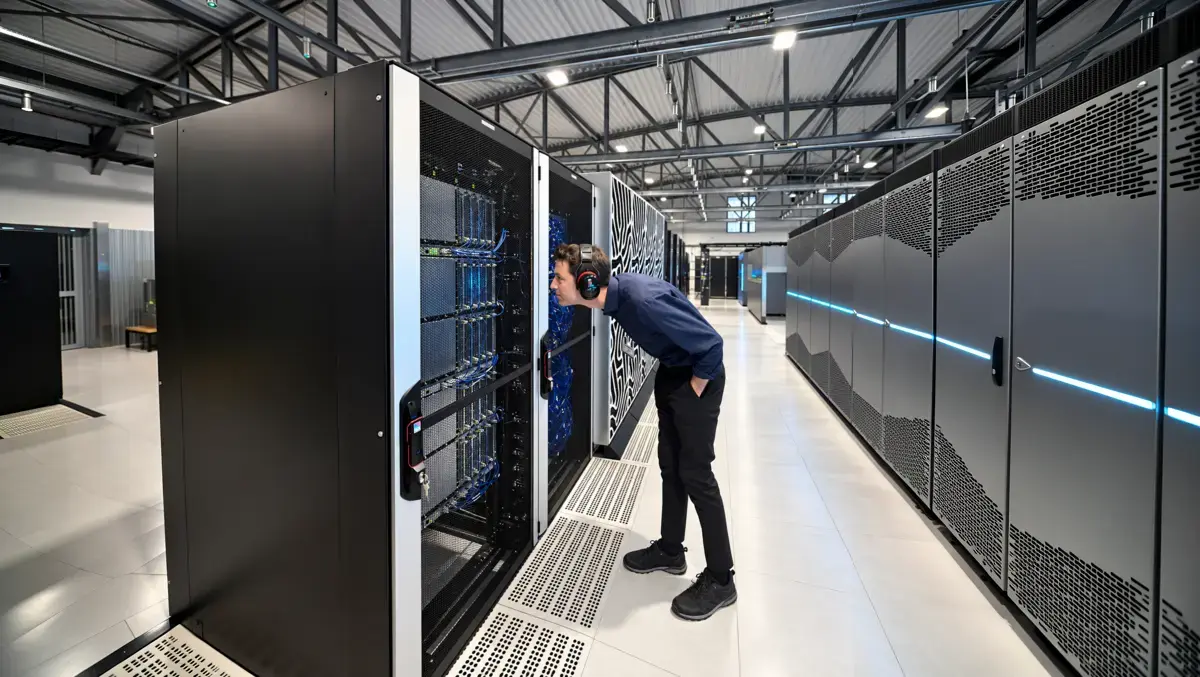

Sparxity has deployed a sparse-native computing rack system at the Jülich Supercomputing Centre in a multi-million-dollar project.
The system will support sparse machine learning models and large-scale high-performance computing simulations at the German research site, part of Forschungszentrum Jülich and home to Europe's first exascale supercomputer.
The deployment comes as the company changes its name from SpiNNcloud to Sparxity. It said the new identity reflects its focus on sparse-native computing, which processes only selected activity instead of running dense computation across all operations.
At Jülich, the installed system is called JUBIS. Sparxity described it as event-based, meaning it computes only when activity occurs, and said the installation will test sparse-native computing in an operational supercomputing environment.
JUBIS is designed to deliver 10X faster sparse solver execution, 18X lower energy consumption for event-based machine learning workloads and 20X shorter time to an acceptable solution in optimisation problems, according to Sparxity.
Those figures highlight one of the core issues facing operators of advanced computing infrastructure: the rising cost and power demands of artificial intelligence and large simulation workloads. Sparse computing has attracted interest as one way to reduce data movement and limit the amount of computation required, particularly where not every parameter or operation needs to be active at the same time.
Supporters of the approach argue that software developers and researchers have spent years adapting models to hardware built for dense computing. In that view, purpose-built sparse systems could enable different model designs and efficiency gains for both research computing and commercial AI inference.
Research focus
Jülich is one of Europe's best-known supercomputing centres and has expanded its role in AI research alongside its traditional high-performance computing work. It is also home to the JUPITER AI Factory, which Sparxity described as one of 19 such facilities in Europe and the only one built around an exascale machine.
That makes the Jülich deployment significant for Sparxity, placing the company's hardware in a large-scale research environment with demanding workloads. It also gives the centre another platform for neuroscience and simulation work that may benefit from sparse machine learning techniques.
"Sparse machine learning represents one of the biggest opportunities to fundamentally improve the efficiency of AI," said Dr Guido Trensch, Simulation and Data Lab Neuroscience, Jülich Supercomputing Centre.
"By adopting Sparxity, we're able to complement our globally unique HPC infrastructure with a fundamentally new approach, opening up new research opportunities so that we can further develop advancements in neuroscience," said Trensch.
Strategic shift
For Sparxity, the project also marks a strategic moment beyond the installation itself. The company said its current systems serve both high-performance computing and AI, while its next generation is aimed entirely at sparsity for AI inference.
Rather than offering a chip alone, Sparxity said it builds full-stack systems spanning silicon and software. That places it in a market where infrastructure providers are trying to stand out not only through processor design but also through integrated system architecture and workload-specific optimisation.
Sparse-computing specialists argue that conventional hardware has limited the extent to which model developers can use fine-grained and dynamic sparsity. In practice, the commercial test for that claim will depend on whether such systems fit into existing software stacks, deliver consistent gains across real workloads and justify the cost of adoption for datacentres and research institutions.
"Model builders have spent years designing around the limits of dense hardware," said Hector Gonzalez, Co-Founder and Chief Executive Officer, Sparxity.
"Sparxity exists to unlock what they would build without those limits by computing only what matters. Our rebrand focuses entirely on the sparse-native approach as a practical foundation for the next generation of AI infrastructure. Our current systems bring sparsity to both HPC and AI, and our collaboration with Jülich Supercomputing Centre, one of the largest supercomputing facilities in Europe, shows the value of that approach at supercomputer scale," said Gonzalez.
The system at Jülich is supported by the European Regional Development Fund and the State of North Rhine-Westphalia under the EFRE/JTF-Programm NRW 2021-2027 programme.