

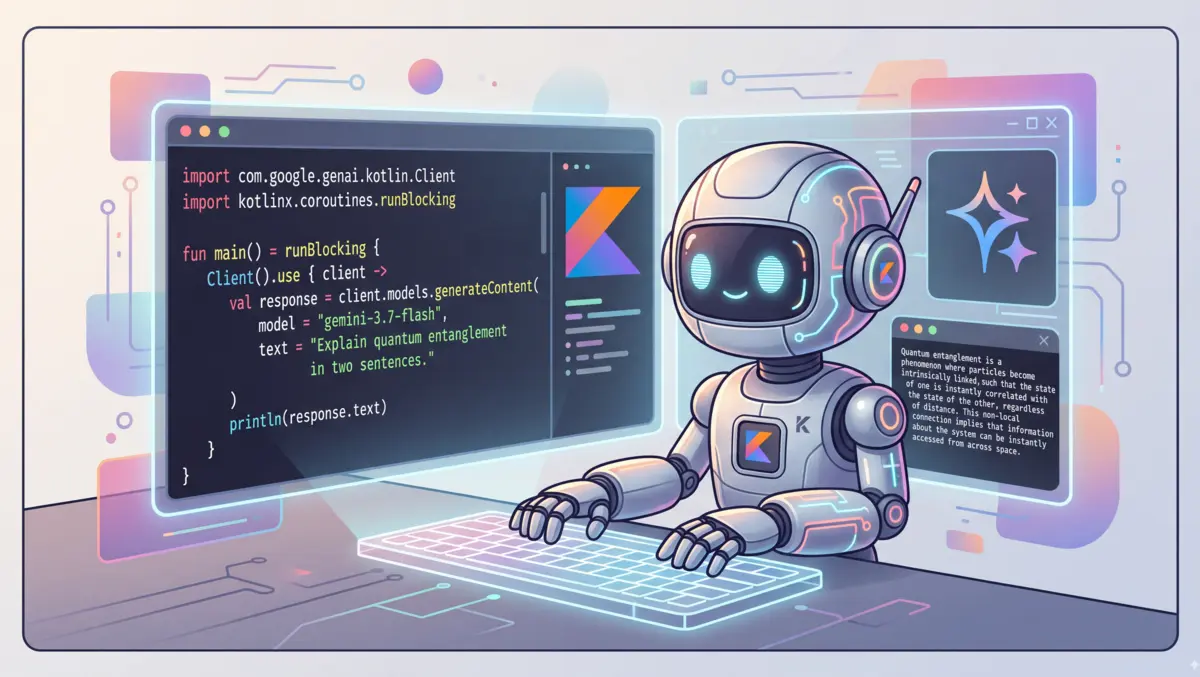

Google has released version 1.0 of its Gen AI SDK for Kotlin, giving Kotlin developers access to Gemini models across Android and JVM environments.
Built as a Kotlin Multiplatform library, the SDK lets developers use the same package in applications running on backend services, serverless functions, desktop systems, and Android. It is available through Maven Central under the package name com.google.genai:google-genai-kotlin.
The launch adds a Kotlin-specific option to Google's expanding set of Gemini developer tools. Instead of relying on raw HTTP integrations or Java libraries, developers can access Gemini services through Kotlin features such as coroutines, Flow-based streaming, and immutable data classes.
At the centre of the package is a Client class for connections and authentication. Google says the same SDK works with the Gemini Developer API through Google AI Studio and with the Gemini Enterprise Agent Platform on Google Cloud, with configuration changes rather than separate codebases.
Core functions
The SDK covers several common generative AI use cases in application development, including single-prompt text generation, streaming responses, multi-turn chat, image analysis, image generation, live interactive sessions, and function calling.
For text-based tasks, developers can send one-off prompts to Gemini models and receive a response through a standard Kotlin call. The SDK also supports streamed output through Kotlin Coroutine Flow, which suits interfaces where users need to see text arrive incrementally rather than wait for a complete answer.
Google has also included a chat service that tracks conversation history between requests. This removes the need for developers to format and resend earlier turns manually when building applications that depend on continuing context.
Images and search
Beyond text, the SDK supports multimodal requests. Developers can send image files alongside text prompts and ask Gemini to analyse the content. In one example, an anatomical diagram was checked against web sources through Google Search grounding, with the response returning generated text as well as search queries and cited source material.
The package also supports Google's image generation models. Generated images are returned as byte data in the model response, allowing developers to save the resulting file directly in an application workflow.
Another supported use case is conversational image editing. In this setup, a developer can submit an existing image with instructions to alter it, such as changing lighting or other visual characteristics, within a single request.
Live sessions
For real-time interactions, the SDK supports the Gemini Live API through WebSocket sessions. This enables applications to exchange text, audio, and other live inputs with Gemini while receiving responses as the session continues.
Google says this part of the SDK supports low-latency voice and audio scenarios. In the sample implementation, a session is opened, server messages are collected continuously, and the client can send text or audio input before closing the session.
The release also adds support for structured tool use. Developers can define JSON schemas for functions a model may call, allowing Gemini to trigger external tools or internal services during a conversation or task flow.
One form is standard function calling, in which the model returns a function call request for the application to handle. Another is automatic function calling in chat sessions, where the SDK can invoke declared functions on the developer's behalf when needed in the exchange.
Kotlin focus
The product is aimed squarely at Kotlin developers, a group that spans Android mobile development and a growing server-side ecosystem using frameworks such as Ktor, Spring Boot, Quarkus, and Micronaut. By packaging Gemini support in a native Kotlin form, Google is seeking to make its AI services easier to use in projects that already rely on Kotlin-first tools and coding patterns.
The move may also reflect wider competition among AI providers to meet developers in their preferred languages rather than expecting them to integrate through lower-level interfaces. For teams building consumer apps, internal tools, or cloud services in Kotlin, a dedicated SDK can reduce the work needed to connect model access, streaming, live sessions, and multimodal features in one codebase.
The software can authenticate through API keys for Google AI Studio or through standard Google Cloud application credentials when used with Google's enterprise setup. Google says the client manages the underlying HTTP connections automatically and supports resource cleanup through Kotlin's use extension.
The release brings together a broad range of Gemini capabilities in a single Kotlin package, from simple prompt-response interactions to image workflows and live bidirectional sessions over WebSockets.