

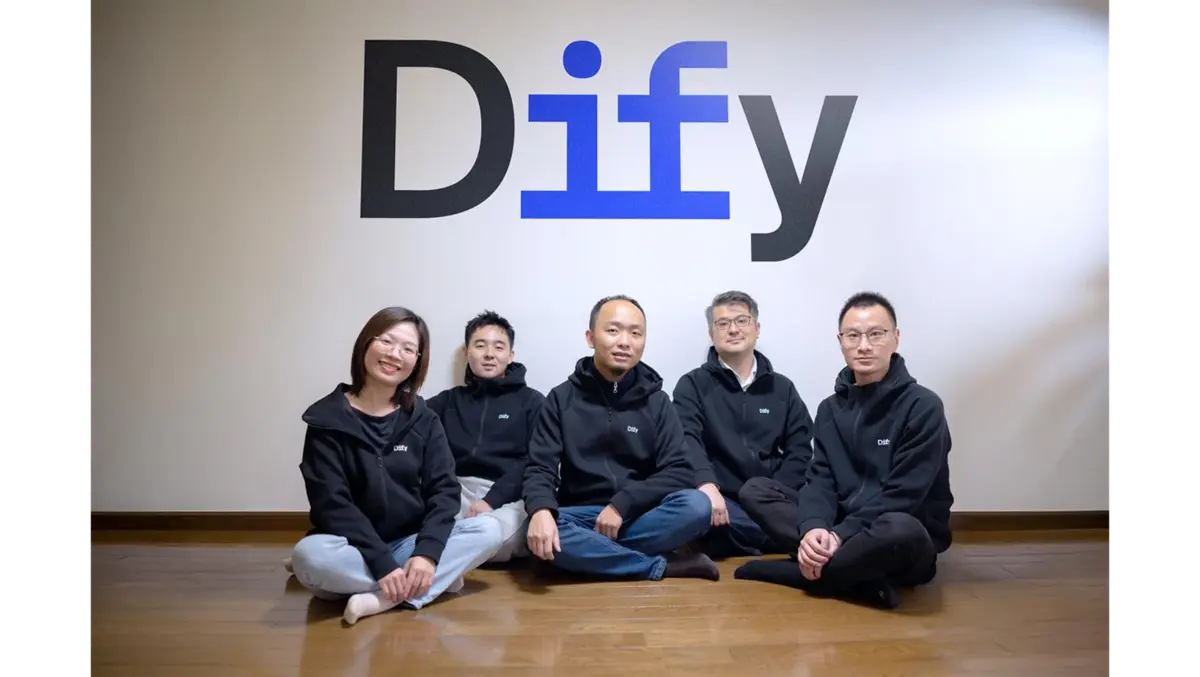
Dify raises USD $30m to scale open-source AI workflows
Tue, 10th Mar 2026%201.webp)
Dify has raised USD $30 million in a Series Pre-A round as it looks to expand development of its open-source platform for building and running "agentic workflows" based on large language models.
HSG led the round, with participation from GL Ventures, Alt-Alpha Capital, 5Y Capital, Mizuho Leaguer Investment, and NYX Ventures. Alt-Alpha Capital is a spin-out from Bessemer Venture Partners. 5Y Capital participated again and increased its investment.
Dify positions its software as an operational layer between AI models and business systems, aimed at teams looking to move from prototypes to deployed workflows without building supporting infrastructure from scratch.
Open-source footprint
Dify says it is the 51st most-starred open-source project on GitHub and runs on more than 1.4 million machines worldwide, with users in more than 175 countries and regions.
More than 2,000 teams and 280 enterprises use the product, according to the company. It says customers are shifting from adopting AI tools to building AI-driven solutions within Dify.
Founded in March 2023, Dify has offices in the San Francisco Bay Area, Tokyo, Shanghai, and Suzhou.
Product approach
The platform includes a visual builder for composing workflows, along with deployment and operations tooling designed for production environments.
Dify argues that organisations need to move beyond chat interfaces because routine work spans documents, systems, and repeatable processes, and often requires inputs, approvals, and accountability. From that perspective, agent-style workflows become most relevant when they connect to existing business systems and formal processes.
Examples include document review pipelines, internal copilots that draw on enterprise knowledge, customer support automation with escalation steps, and operational workflows such as invoice auditing and correspondence drafting.
Maersk and ETS were cited as platform users.
"Dify gave us a practical way to move beyond prototypes and actually operationalize AI workflows. We were able to turn real business processes into maintainable systems, without rebuilding infrastructure every time," said Mark Sear, Director of AI Solutions Engineering, Maersk.
ETS described its use in the context of natural language processing pipelines.
"Dify's intuitive interface allows our teams to rapidly design and deploy complex natural language processing pipelines, enabling us to improve the quality of our assessment products while reducing cost and time to market," said Gary Feng, Director of AI at ETS.
Funding priorities
The company says it will use the funding to focus on four areas. First is "production-ready agents and workflows," including building blocks, debugging, and predictability under load.
Second is "enterprise foundations," with an emphasis on performance, compliance, permissions, and auditability for organisations that need operational controls around AI tooling.
Third is lowering the barrier to building AI workflows, intending to enable people with domain expertise, not only software developers, to build useful systems directly.
Fourth is expanding the open-source ecosystem around the platform, with more templates, plugins, and connectors, and clearer paths for community contributions.
Dify also outlined a broader view of how workplace software may evolve, arguing that organisations will build their own agents, workflows, and interfaces as a single effort spanning system logic and user experience.
The company is hiring across its locations and expects adoption to continue spreading through developers as it invests in broader usability.