


Zoom has expanded its agentic AI offering across its workplace collaboration, phone and customer experience products, adding workflow automation, custom AI agents, and new AI-based document and presentation tools.
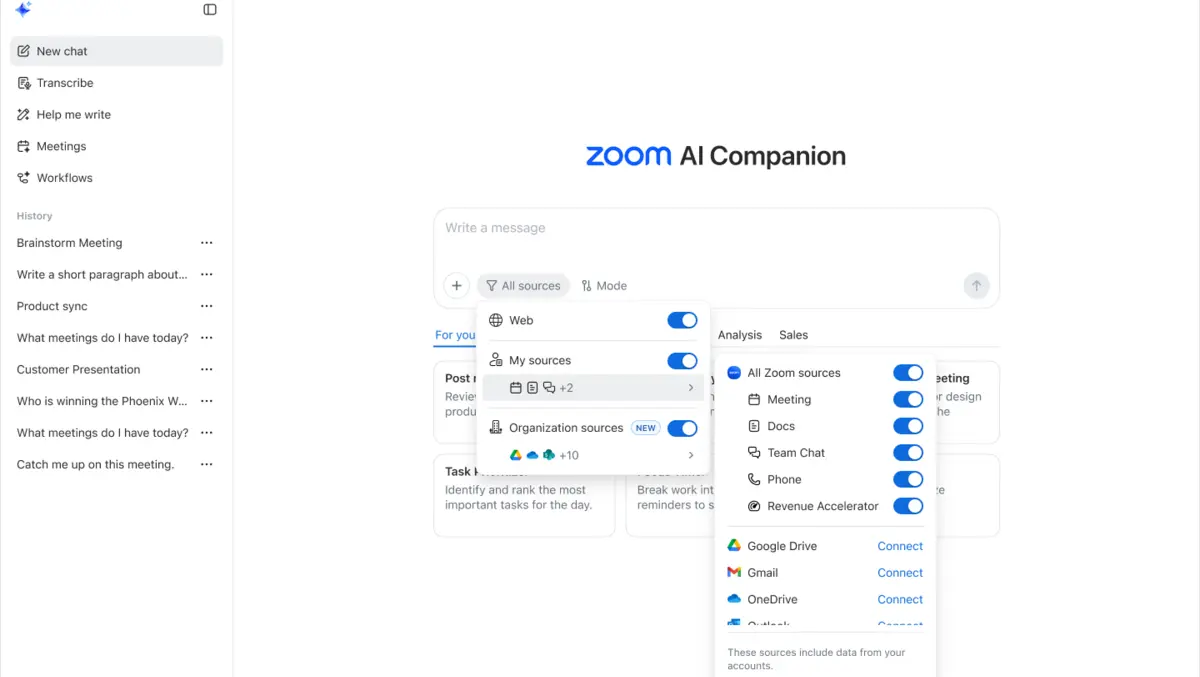
The update centres on a broader rollout of AI Companion 3.0 across Zoom Workplace, Zoom Business Services and Workvivo. Zoom is positioning it as a shift from meeting summaries to automated follow-through, where meeting, call and chat activity can trigger actions across software systems.
"The next phase of enterprise AI will be defined by the ability to move from conversation to action," said Velchamy Sankarlingam, President of Product & Engineering, Zoom. "Zoom's agentic AI platform is designed to orchestrate action across systems, turning every meeting, call, and customer interaction into a trigger for workflow automation."
Broader AI companion
AI Companion 3.0 was previously available in a web browser and is now rolling out more broadly across Zoom's applications. Monthly active users more than tripled year on year in the fourth quarter of Zoom's 2026 financial year, as usage shifted from experimentation to routine work.
Zoom says the expanded AI Companion connects conversations with enterprise data and applications. It describes this as part of a federated approach, with security controls designed for business use.
Custom AI agents
A Custom AI Companion add-on introduces a no-code interface for creating AI agents. These agents can run workflows inside Zoom and across third-party systems including Salesforce, Slack and ServiceNow.
Zoom also listed prebuilt agent templates for functions such as Sales, IT and Marketing. The design targets repetitive post-meeting and post-call tasks, such as drafting follow-up messages, updating records, and routing requests to other teams.
Separately, Zoom says AI Companion will gain third-party connectors for enterprise search and retrieval, including 10 secure connectors. Supported systems include Salesforce, ServiceNow, Box, Google Drive and OneDrive, allowing workflows to pull in content and data.
Personalisation and memory features sit alongside these connectors. Zoom says AI Companion can learn from user context, such as role and preferences, to deliver tailored insights and recommendations.
AI canvases
Zoom is also adding "AI-first canvases" called Zoom AI Docs, AI Sheets and AI Slides. Built into Zoom Meetings, the tools aim to convert conversations into structured outputs.
AI Docs focuses on drafting and structuring documents from meeting content. AI Sheets organises information in tables for analysis and tracking. AI Slides creates presentation material in real time as teams discuss content.
Zoom is positioning the canvases as a way for teams to co-create without switching applications. In recent years, it has pushed to keep more work artefacts in its core meeting and chat experience, rather than using Zoom only as a communications layer.
Developer APIs
Zoom also introduced Zoom AI Services, a suite of AI APIs. The APIs cover speech, language and reasoning functions, including transcription, translation, summarisation and image processing.
The move places Zoom among a growing set of collaboration software providers packaging AI features for developers, and suggests a strategy of making internal AI components available for custom applications and integrations.
Workplace updates
Zoom Workplace is receiving interface changes and new agentic features, including a cleaner design across desktop, mobile and web. An AI Companion tab acts as a conversational work surface for queries, writing and workflow automation.
Other additions include a group assistant called Zoomie, which works across Zoom Rooms, Meetings and Chat. Zoom also detailed AI-based chat features such as topic summaries and prioritisation through a "For You" view.
The rollout also includes language and security updates. Live voice translation in Zoom Meetings will launch with five languages, with more planned. Zoom also described deepfake risk detection to identify synthetic audio or video and issue real-time alerts during meetings.
Phone and contact centres
For Zoom Phone, the update adds AI-driven workflows and a stronger mobile focus. Zoom Phone supports more than 10 million seats globally, and has become central to Zoom's move beyond video meetings.
Zoom plans to add agentic workflows for tasks such as drafting emails and sending post-call summaries. It is also expanding its virtual receptionist with SMS support. Now labelled SMS for Zoom Virtual Agent AI Receptionist, the feature adds text handling for customer enquiries, information capture, scheduling flows and escalation to a human agent.
Zoom Phone Mobile introduces a mobile experience that enables business calls from the native dialler, while retaining AI calling features.
Zoom also renamed its analytics add-on for customer-facing teams. Customer Engagement Pack, previously called Power Pack, adds analytics and AI insights across calls and SMS.
CX automation
Zoom CX and Zoom Revenue Accelerator are set to gain further automation features. Upcoming changes include Zoom Virtual Agent 3.0 and AI Expert Assist 3.0 for the contact centre.
AI Expert Assist 3.0 is positioned as a real-time layer for agents and supervisors, providing contextual guidance and executing tasks. CX Insights adds natural-language querying over interaction transcripts and operating metrics. Customer Workflow Orchestration enables natural-language creation of workflows triggered by contact centre events or signals from systems such as CRM and ERP.
Zoom also outlined quality management tools for monitoring automated interactions, and new sales functions in Zoom Revenue Accelerator. AI Sales Assist provides real-time prompts and next actions during sales calls, while Ask ZRA enables natural-language analysis across calls and deals.
Features across Workplace, Phone and CX will roll out on varying timelines, with availability details expected alongside Zoom's Enterprise Connect announcements.